
Last Updated: Jun 15, 2022
Quick Links: Table of Contents
- Australian Shepherd Versus Havanese: Introduction
- Australian Shepherd versus Havanese: Overview
- Australian Shepherd versus Havanese: Comparison Table
- The Most Remarkable Differences Between the Australian Shepherd and the Havanese
- The Similarities Between the Australian Shepherd and the Havanese
- Size Comparison of the Australian Shepherd versus Havanese
- Appearance (Colors) of the Australian Shepherd and the Havanese
- Lifespan of Australian Shepherd versus Havanese
- Temperament of the Havanese Versus the Australian Shepherd
- Price of Australian Shepherd versus Price of Havanese
- Adopting the Australian Shepherd versus Adopting the Havanese
- The Popularity of Australian Shepherd versus Popularity of Havanese
- Health Problems of Australian Shepherd versus Health Problems of Havanese
- Tolerates Being Alone: Australian Shepherd versus Havanese
- Do Australian Shepherds shed more than Havaneses?
- Which is Easier to Groom, the Australian Shepherd or the Havanese?
- Which Dog Breed is more Dog-Friendly, the Australian Shepherd or the Havanese?
- Are Australian Shepherds good family dogs? What about Havaneses?
- Is the Australian Shepherd Easier to Train than the Havanese?
- Which one drools more, the Australian Shepherd or the Havanese
- How Kid-friendly are Australian Shepherds and Havaneses?
- Does the Australian Shepherd Have a Higher Prey Drive than the Havanese?
- Do Australian Shepherds Bark and Howl? What about Havaneses?
- Can Australian Shepherds Tolerate Cold Weather? And can Havaneses Tolerate Cold Weather?
- Wanderlust Potential: Australian Shepherd vs. Havanese
- Can Australian Shepherds Tolerate Hot Weather? Can Havaneses Tolerate Hot Weather?
- Australian Shepherd Versus Other Dog Breeds
- Conclusion: Australian Shepherd versus Havanese. Which One is a Better Pet?
Australian Shepherd Versus Havanese: Introduction
Are you thinking of getting a new pet dog, and you have narrowed down your choices to the Australian Shepherd and the Havanese? Well, you have come to the right place. Because in this article, we will provide you with a detailed comparison of these two dog breeds to help you decide which of the Australian Shepherd and the Havanese better suits you.
We will provide you a detailed discussion and comparison of dog attributes such as intelligence, price, general health, friendliness, etc, for both the Australian Shepherd and the Havanese.
Furthermore, we will let you know which one of the Australian Shepherd and the Havanese is better suited for new dog owners, for owners with kids, for owners that live in apartments, for owners with dog allergies, etc.
Importantly, we did some analysis and calculation and we obtained a number that we call the Better-Pet Score™ for both the Australian Shepherd and for the Havanese. The dog breed with the higher Better-Pet score is the `better` pet. We hope that these Better-Pet Scores will provide you with more insight into deciding which pet to get between the Australian Shepherd and the Havanese.
Our only goal here is to help you make a well-thought-out decision on your next long-term companion, be it the Australian Shepherd or the Havanese.

Australian Shepherd versus Havanese: Overview
A very important difference between the Australian Shepherd and the Havanese is the size difference between the two dog breeds. The Australian Shepherd is a medium-sized dog while the Havanese is a small-sized dog.
Furthermore, the Australian Shepherd belongs to the Herding Dogs group. Herding Dogs were bred for moving livestock, including sheep, cattle, and even reindeer. Herding dogs work closely with their human shepherds, and their natural intelligence and responsiveness make them highly trainable. They have high levels of energy, which needs to be channeled properly to prevent destructive behavior. Herding breeds are protective of their people and property and make excellent watchdogs. Their intelligence, agility, and activity level make them well suited to dog sports.
On the other hand, the Havanese belongs to the Companion Dogs group. Companion Dogs were bred to be companions for humans. Their main goal in life is to be with people, and they will be very sad if left to themselves for long hours day after day.
Australian Shepherd versus Havanese: Comparison Table
The table below compares the Australian Shepherd to the Havanese based on different important factors such as Price, Health, Kid-friendliness, etc.
When a dog breed scores higher for a factor than the other dog breed, the box of the breed that scores higher is shaded green and the box of the breed that scores lower is shaded red. When there is no difference between the breeds for a particular factor then the box is shaded gray for both pets. Also, when the factor is not important in picking a pet, or when the factor cannot be compared between two pets, the box for the factor is shaded gray for both pets
Most of the factors in the table for each dog breed are ranked on a scale of 1 to 5. “1” means “worst”, and “5” means “best”.
However, some factors such as “Price”, “Average Lifespan”, etc. cannot be on a scale of 1 to 5, so they are not on a scale of 1 to 5 in the comparison table.
Later in this article, we will further explain each factor as it applies to the Australian Shepherd and the Havanese
| Factor | Australian Shepherd | Havanese |
|---|---|---|
| Adapts Well To Apartment Living | 1/5 | 5/5 |
| Does NOT Drool | 5/5 | 5/5 |
| Easy To Groom | 1/5 | 1/5 |
| Life Span | 12 to 15 years | 12 to 15 years |
| Height | 18 to 23 inches tall at the shoulder | 8 to 11 inches tall at the shoulder |
| Good For Novice Owners | 2/5 | 5/5 |
| Tolerates Being Alone | 2/5 | 1/5 |
| General Health | 2/5 | 3/5 |
| Friendly Toward Strangers | 3/5 | 5/5 |
| Does NOT Shed | 3/5 | 4/5 |
| Tolerates Cold Weather | 4/5 | 3/5 |
| Tolerates Hot Weather | 4/5 | 4/5 |
| Kid-Friendly | 4/5 | 4/5 |
| Potential NOT to Gain Weight | 2/5 | 2/5 |
| Does NOT chew on things | 2/5 | 3/5 |
| Low Prey Drive | 2/5 | 2/5 |
| Does NOT Bark or Howl | 2/5 | 4/5 |
| Calmness/ Low Vigor | 2/5 | 4/5 |
| Weight | 40 to 65 pounds | 7 to 13 pounds |
| Easygoing | 1/5 | 2/5 |
| Affectionate With Family | 5/5 | 5/5 |
| Dog Friendly | 5/5 | 5/5 |
| Easy To Train | 5/5 | 5/5 |
| Intelligence | 5/5 | 4/5 |
| Tendency NOT to Wander | 1/5 | 4/5 |
| NOT Rambunctious | 1/5 | 3/5 |
| Minimal Exercise Needs | 1/5 | 3/5 |
| Potential For Playfulness | 5/5 | 5/5 |
| Average Lifespan | 13.5 years | 13.5 years |
| Average Price | $1180 | $2180 |
| Price Range | $800 – $1500 | $1700 – $2750 |
| Temperament Score | 82.2 percent | 81.8 percent |
| Common Health Problems and Recommended Health Tests | ||
| Popularity out of 200 Dog Breeds | 15 | 23 |
Next, we added the scores of the factors that can be added together for the Australian Shepherd in the table (that is, `Ease of Grooming` score + `General Health` score + `Calmness` score + …etc) and we compared it to the corresponding total score for the Havanese. We call these total scores the Better-Pet Scores, as we mentioned earlier. We called this score the Better-Pet score because the better dog breed will have a higher score. This is because the pet will the higher score will have minimal needs and be easier to have as a pet.
The Better-Pet score for the Australian Shepherd is 70 out of 125 while the Better-Pet score for the Havanese is 91 out of 125.
Despite the higher Better-Pet score of the Havanese, we still believe that the Australian Shepherd is a better pet than the Havanese.
This is because Australian Shepherds are much cuter but you cannot put a score on cuteness. If you could put a score on cuteness, then the Australian Shepherd will come out on top.
Also, we are biased in favor of the Australian Shepherd :-). We are for the Australian Shepherd. So get a Australian Shepherd!

The Most Remarkable Differences Between the Australian Shepherd and the Havanese
Below is a list of where the Australian Shepherd and the Havanese are most different:
The Similarities Between the Australian Shepherd and the Havanese
The Australian Shepherd and the Havanese are very similar in certain aspects. Below is the list of where the Australian Shepherd and the Havanese are most similar:
Size Comparison of the Australian Shepherd versus Havanese
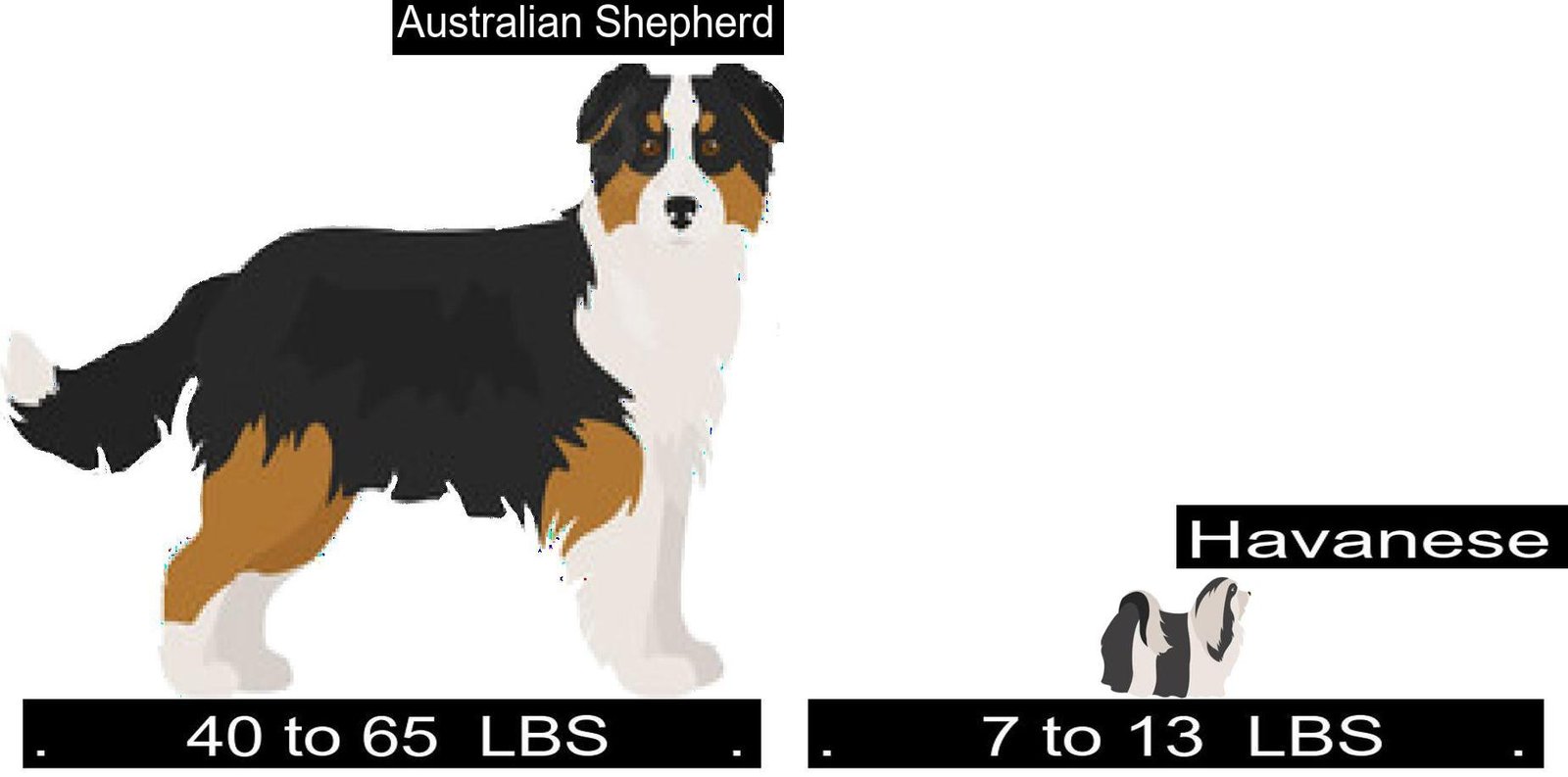
Now, let us discuss the difference in size between the Australian Shepherd and the Havanese.
The Australian Shepherd weighs 40 to 65 pounds when fully grown. The Australian Shepherd is 18 to 23 inches tall at the shoulder when fully grown.
On the other hand, the Havanese weighs 7 to 13 pounds when fully grown. The Havanese is 8 to 11 inches tall at the shoulder when fully grown.
Appearance (Colors) of the Australian Shepherd and the Havanese
Australian Shepherd Colors
The Australian Shepherd comes in the following beautiful primary colors:
- Brown / Chocolate
- Tricolor (Brown, Black, & White)
- Black
- Merle (Red)
- Gray / Blue / Silver
- Red / Chestnut / Orange
- Yellow / Tan / Blond / Fawn
- Harlequin
- Merle (Blue)
- White / Cream
- Apricot / Beige
- Bicolor
- Golden
- Brindle
The Australian Shepherd comes in the following lovely secondary colors in addition to its primary colors:
- White / Cream
- Brown / Chocolate
- Yellow / Tan / Blond / Fawn
- Red / Chestnut / Orange
- Black
- Tricolor (Brown, Black, & White)
- Sable
- Gray / Blue / Silver
- Merle (Blue)
Havanese Colors
The Havanese comes in the following beautiful primary colors:
- Apricot / Beige
- Tricolor (Brown, Black, & White)
- Black
- White / Cream
- Yellow / Tan / Blond / Fawn
- Gray / Blue / Silver
- Brown / Chocolate
- Bicolor
The Havanese comes in the following lovely secondary colors in addition to its primary colors:
- White / Cream
- Gray / Blue / Silver
- Bicolor
- Black
- Brown / Chocolate
- Yellow / Tan / Blond / Fawn
Lifespan of Australian Shepherd versus Havanese
The lifespan of the Australian Shepherd is between 12 to 15 years. The average lifespan of the Australian Shepherd is 13.5 years.
The lifespan of the Havanese is between 12 to 15 years. The average lifespan of the Havanese is 13.5 years.
The Havanese live as long as the Australian Shepherd.

Temperament of the Havanese Versus the Australian Shepherd
The Australian Shepherd has a better temperament than the Havanese.
This is because the temperament score for the Australian Shepherd is 82.2 percent while the temperament score for the Havanese is 81.8 percent, according to the American Temperament Test Society (ATTS).
The American Temperament Test Society (ATTS) is a non-profit organization whose mission is to provide fair and objective evaluations of the temperaments of dog breeds.
Dog breeds with low temperament scores tend to show unprovoked aggression, they easily panic without quickly recovering from the panic, and they tend to avoid people. However, dog breeds with high temperament scores are not aggressive and are not shy. Also, these dogs are generally friendly and are protective of their owners.
The average temperament score across all dog breeds (over 250 breeds) is 83.7 percent.
With its temperament score of 82.2 percent, the Australian Shepherd has a below-average temperament compared to other dog breeds.
With its temperament score of 81.8 percent, the Havanese has a below-average temperament compared to other dog breeds.
The ATTS obtained the temperament scores of the Australian Shepherd and the Havanese by measuring the temperaments of 702 Australian Shepherds and 11 Havaneses.
Price of Australian Shepherd versus Price of Havanese
The average price of the Australian Shepherd puppy is $1180. The price of the Australian Shepherd typically ranges from $800 – $1500. However, the price of a Australian Shepherd can be as low as $100 and as high as $12009. We obtained this price information by reviewing the prices of 2674 Australian Shepherd puppies listed for sale from various sources.
The average price of the Havanese puppy is $2180. The price of the Havanese typically ranges from $1700 – $2750. However, the price of the Havanese can be as low as $600 and as high as $4550. We obtained this price information by collecting and reviewing the prices of 647 Havanese puppies listed for sale from various sources.
The Havanese is more expensive than the Australian Shepherd.
| Australian Shepherd | Havanese | |
|---|---|---|
| Average Price | $1180 | $2180 |
| Price Range | $800 to $1500 | $1700 to $2750 |
The charts below show the price distribution for the Australian Shepherd and Havanese. For different price points, the charts show how many Australian Shepherd puppies or how many Havanese puppies are listed for sale at those price points.
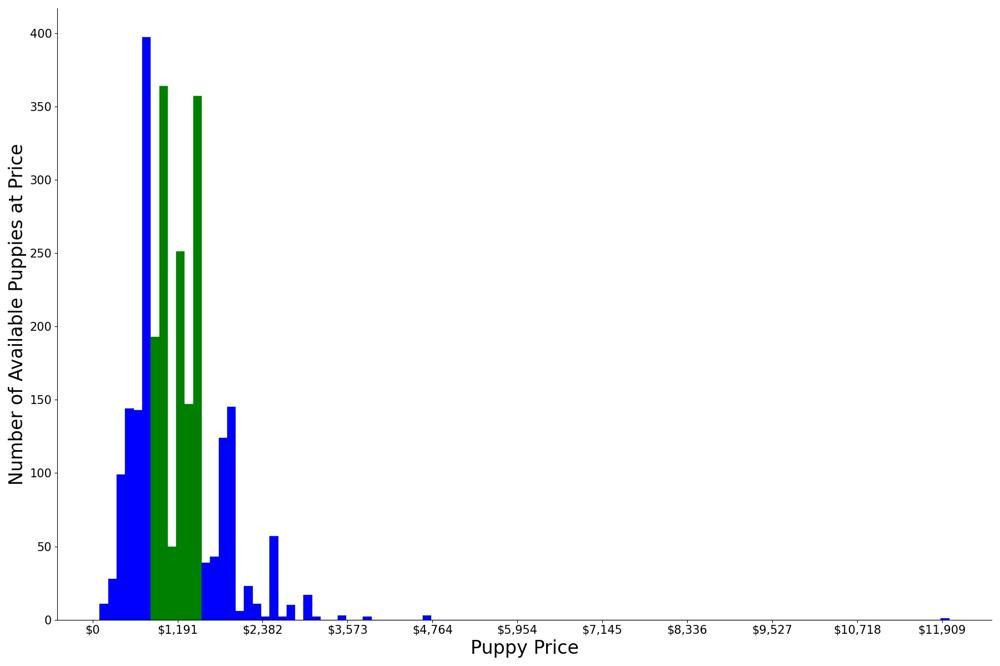
A breakdown of the prices of Australian Shepherds. The typical price range is shaded Green.
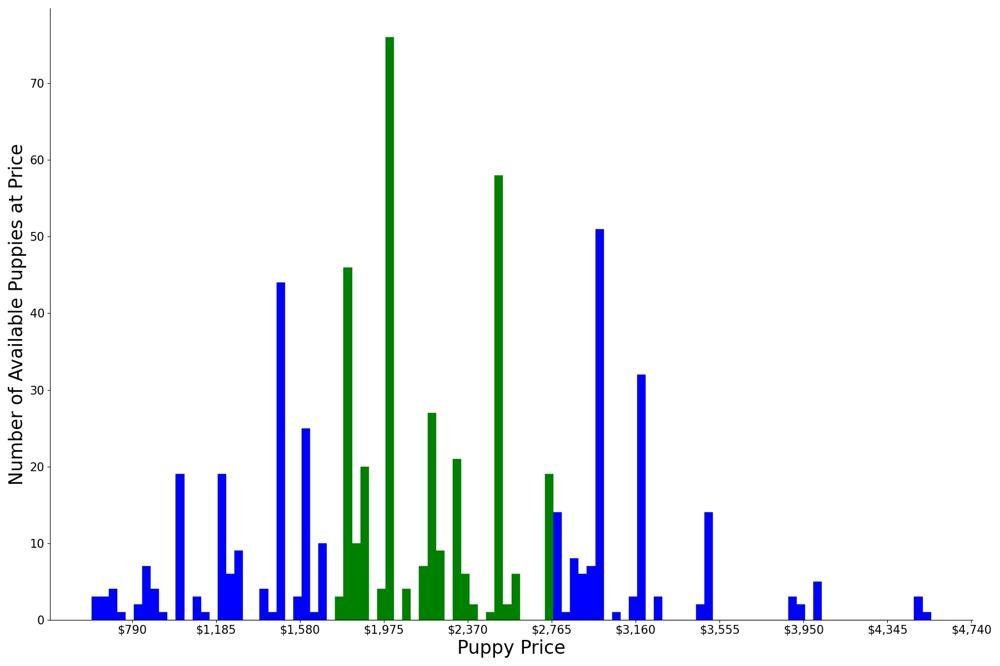
A breakdown of the prices of Havaneses
Note that a lot of factors determine how much you can expect to pay for the Australian Shepherd puppy or the Havanese puppy. This includes if health screening tests have been performed on the puppy, if the puppy is from a famous pedigree, the US State where the puppy is bred, etc.
Nevertheless, when looking to buy a puppy, look at buying a puppy only from well-established breeders that breed puppies primarily for the love of dogs, and secondarily for profit. Do not buy a puppy from a puppy mill. Puppy mills mass-produce puppies in bad living conditions for maximum profit.
You may also consider adopting a dog instead of buying a dog.

Adopting the Australian Shepherd versus Adopting the Havanese
You may consider adopting a dog instead of buying a puppy. Many Australian Shepherds and many Havaneses are currently available for adoption.
These adorable and cute dogs are waiting in dog shelters hoping that someday someone will rescue them. Furthermore, adoption costs are lesser than the cost of a new puppy. Dog adoption costs are usually around $300. In addition to your local dog shelter, a good place online to see dogs that are available for adoption is petfinder.com.
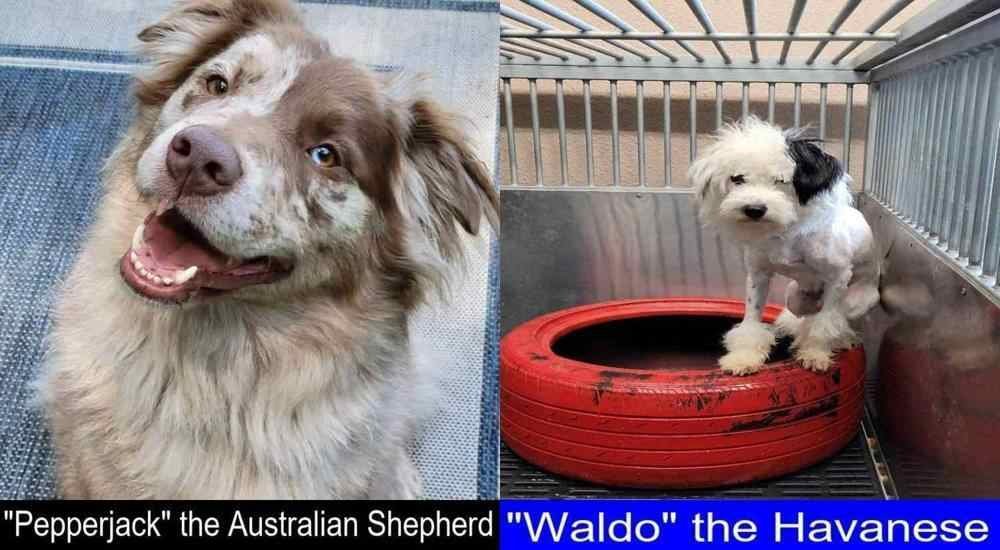
Below is an adorable Male Australian Shepherd named Pepperjack that is currently available for adoption on Petfinder.com. You can find other lovely adoptable Australian Shepherds like Pepperjack on pefinder.com.
Also, like Australian Shepherds, Havaneses are also available for adoption. For example, Waldo is a Male Havanese that is currently available for adoption on petfinder.com. You can find more Havaneses like Waldo that are up for adoption on petfinder.com.
Blue is the name of another Australian Shepherd (Male) on petfinder.com that is looking for a new home.
Also, Declan is an adorable Male Havanese on petfinder.com that you can adopt.

You can find more Australian Shepherds and Havaneses that are available for adoption on petfinder.
The Popularity of Australian Shepherd versus Popularity of Havanese
Every year, the American Kennel Club (AKC) publishes information on how popular a dog breed is in that particular year. The AKC gets the popularity information of a breed from how many dogs of that breed the owners register with the AKC every year. The AKC collects this data for about 200 dog breeds. The AKC collects this data for purebred dogs only(no mixed or hybrid dogs).
The graphs and the table below show the popularity of the Australian Shepherd and the Havanese over the years.
Based on the AKC popularity data over the years, the Australian Shepherd is more popular with dog owners than the Havanese. This is because, over the years, the average popularity of the Australian Shepherd is 15 out of about 200 dog breeds while the average popularity of the Havanese is 23 out of about 200 dog breeds.
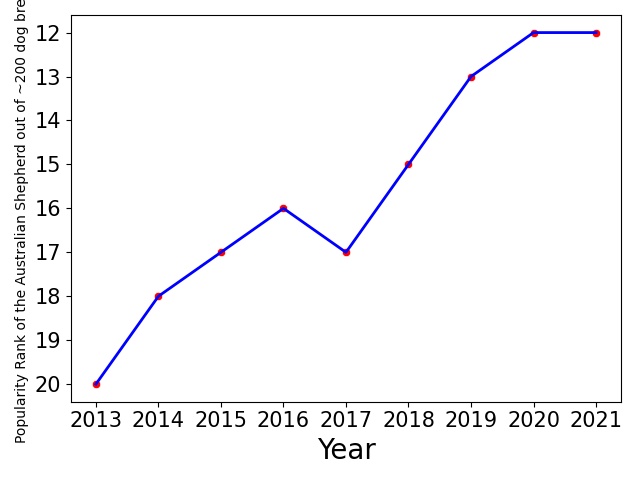
Popularity of Australian Shepherd
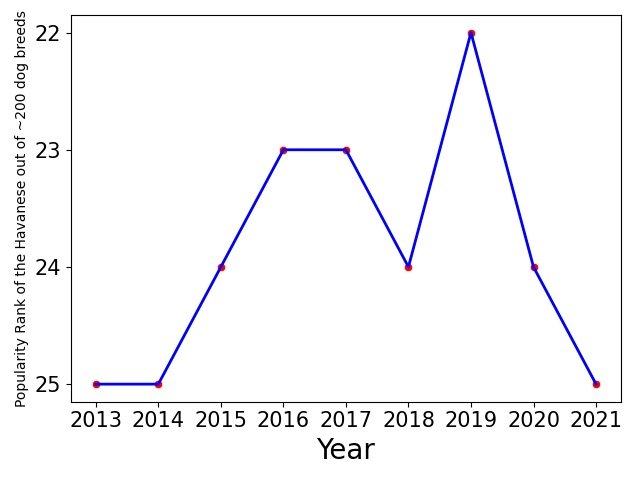
Popularity of Havanese
| Year | Australian Shepherd Popularity Rank | Havanese Popularity Rank |
|---|---|---|
| 2013 | 20 | 25 |
| 2014 | 18 | 25 |
| 2015 | 17 | 24 |
| 2016 | 16 | 23 |
| 2017 | 17 | 23 |
| 2018 | 15 | 24 |
| 2019 | 13 | 22 |
| 2020 | 12 | 24 |
| 2021 | 12 | 25 |
Health Problems of Australian Shepherd versus Health Problems of Havanese
Every dog breed has its own set of health problems that it has a tendency to develop. There is nothing like a perfect dog breed.
Both the Australian Shepherd and the Havanese are prone to certain genetic health conditions. The Orthopedic Foundation for Animals (OFA) is the organization that keeps track of health problems in dogs. Based on the extensive records that the OFA keeps, the OFA knows what health problems each dog breed is naturally prone to develop. Hence, the OFA recommends which health screening that breeders should perform on a dog breed to make sure that the breeders won`t breed `defective` dog parents that can pass down defective genes to their puppy offspring.
The more health problems a dog breed is prone to develop, the more health tests the OFA will recommend for that dog breed.
Based on our review of OFA records, we found that the Australian Shepherd is prone to more genetic health problems than the Havanese.
This is because the OFA recommends more screening health tests for the Australian Shepherd than for the Havanese.
7 health tests are recommended for Australian Shepherd while 4 tests are recommended for the Havanese.
Below is a detailed discussion of health problems in Australian Shepherds and in Havaneses.
Australian Shepherd Health Problems
Australian Shepherds are genetically prone to certain health problems. However, breeders can reduce the chances of producing Australian Shepherd puppies with genetic defects by making sure that a puppy`s parents are free from genetic health problems before allowing the parent to make puppies.
The OFA provides breeders recommendations on which genetic diseases that breeders should screen their dog parents and puppies for.
If you want a Australian Shepherd puppy that will grow up to be healthy, make sure that your Australian Shepherd breeder screens your puppy or your puppy`s parents for the health problems that the OFA recommends for your puppy`s breed. This will increase the chances that your puppy is free from genetic defects.
The following are the health tests that Orthopedic Foundation for Animals (OFA) recommends that breeders should screen Australian Shepherds for:
You can find out more about OFA`s recommended tests for Australian Shepherds here.
Havanese Health Problems
Havaneses are genetically prone to certain health problems. However, breeders can reduce the chances of producing Havanese puppies with genetic defects by making sure that a puppy`s parents are free from genetic health problems before allowing the parent to make puppies.
The OFA provides breeders recommendations on which genetic diseases that breeders should screen their dog parents and puppies for.
If you want a Havanese puppy that will grow up to be healthy, make sure that your Havanese breeder screens your puppy or your puppy`s parents for the health problems that the OFA recommends for your puppy`s breed. This will increase the chances that your puppy is free from genetic defects.
The following are the health tests that Orthopedic Foundation for Animals (OFA) recommends that breeders should screen Havaneses for:
You can find out more about OFA`s recommended tests for Havaneses here.
More Discussions on Health Problems in Australian Shepherds and Havaneses
Based on our analysis of data from the Orthopedic Foundation for Animals, of all known genetic health problems in dogs, the health problem that is most commonly seen in the Australian Shepherd Breed is Cataracts problems.
This is because the Australian Shepherd ranks 1 out of 5 dog breeds for Cataracts problems. In fact, in a health test conducted on 107 Australian Shepherds, 2 of them had Cataracts problems.
The genetic diseases that were found to commonly occur in Australian Shepherds, and how common these diseases are in Australian Shepherds relative to other dog breeds, are given below:
Based on our analysis of data from the Orthopedic Foundation for Animals, of all known genetic health problems in dogs, the health problem that is most commonly seen in the Havanese Breed is Dentition Database problems.
This is because the Havanese ranks 3 out of 49 dog breeds for Dentition Database problems. In fact, in a health test conducted on 371 Havaneses, 106 of them had Dentition Database problems.
The genetic diseases that were found to commonly occur in Havaneses, and how common these diseases are in Havaneses relative to other dog breeds, are given below:
The table below lists the common health problems in Australian Shepherd and in Havanese and the rank (prevalence), compared to other dogs, of these health problems in the Australian Shepherd and the Havanese:
| Disease | Australian Shepherd Rank | Havanese Rank |
|---|---|---|
| Cataracts problems | 1 out of 5 dog breeds | Not Common |
| Multiple Drug Resistance (Mdr1) problems | 2 out of 7 dog breeds | Not Common |
| Progressive Retinal Atrophy problems | 7 out of 32 dog breeds | Not Common |
| Degenerative Myelopathy problems | 12 out of 70 dog breeds | Not Common |
| Shoulder problems | 19 out of 22 dog breeds | Not Common |
| Dentition Database problems | 28 out of 49 dog breeds | 3 out of 49 dog breeds |
| Congenital Cardiac problems | 60 out of 159 dog breeds | 70 out of 159 dog breeds |
| Thyroid problems | 66 out of 115 dog breeds | 20 out of 115 dog breeds |
| Elbow problems | 77 out of 144 dog breeds | 55 out of 144 dog breeds |
| Patella problems | 103 out of 145 dog breeds | 59 out of 145 dog breeds |
| Eyes problems | 133 out of 182 dog breeds | 111 out of 182 dog breeds |
| Hips problems | 150 out of 198 dog breeds | 123 out of 198 dog breeds |
| Baer Hearing Test problems | Not Common | 18 out of 21 dog breeds |
| Advanced Cardiac problems | Not Common | 38 out of 71 dog breeds |
*To learn more about each of these diseases, go to OFA.org and search for the disease.
Again, most of these health problems can be prevented through health screening. Responsible breeders screen male and female dog parents for genetic problems. These breeders will only breed dogs that are free of genetic defects. That way, there is little or no chance that their puppies will grow up to have genetic health problems. Always ask a breeder for the list of health tests the breeder screens their dogs for before buying a puppy from such a breeder.
Tolerates Being Alone: Australian Shepherd versus Havanese
Australian Shepherds do not like to be left alone.
Havaneses do not like to be left alone.
Do Australian Shepherds shed more than Havaneses?
Australian Shepherds shed moderately.
Havaneses do not shed a lot. They are good for people with dog allergies.
Which is Easier to Groom, the Australian Shepherd or the Havanese?
Australian Shepherds require a lot of grooming and they are not very easy to groom.
Havaneses require a lot of grooming and they are not very easy to groom.
Which Dog Breed is more Dog-Friendly, the Australian Shepherd or the Havanese?
Australian Shepherds get along very well with other dogs.
Havaneses get along very well with other dogs.
Are Australian Shepherds good family dogs? What about Havaneses?
Australian Shepherds are great family dogs. They are very affectionate with family.
Havaneses are great family dogs. They are very affectionate with family.
Is the Australian Shepherd Easier to Train than the Havanese?
Australian Shepherds are very easy to train.
Havaneses are very easy to train.
Which one drools more, the Australian Shepherd or the Havanese
Australian Shepherds do have a very low tendency to drool.
Havaneses do have a very low tendency to drool.
How Kid-friendly are Australian Shepherds and Havaneses?
Australian Shepherds get along well with kids. They are kid-friendly.
Havaneses get along well with kids. They are kid-friendly.
Does the Australian Shepherd Have a Higher Prey Drive than the Havanese?
Australian Shepherds have a high prey drive. They have the tendency to chase after smaller animals and pets. They do not get along well with other pets.
Havaneses have a high prey drive. They have the tendency to chase after smaller animals and pets. They do not get along well with other pets.
Do Australian Shepherds Bark and Howl? What about Havaneses?
Australian Shepherds are highly vocal. They have the tendency to bark and howl.
Havaneses are not very vocal. They do not tend to bark and howl.
Can Australian Shepherds Tolerate Cold Weather? And can Havaneses Tolerate Cold Weather?
Australian Shepherds can very well tolerate cold weather.
Havaneses can moderately tolerate cold weather.
Wanderlust Potential: Australian Shepherd vs. Havanese
Australian Shepherds have a high tendency to wander. They are easily distracted by other animals or objects.
Havaneses do not have the potential to wander after things that capture their attention. They tend to stay around where you leave them.
Can Australian Shepherds Tolerate Hot Weather? Can Havaneses Tolerate Hot Weather?
Australian Shepherds can tolerate hot weather.
Havaneses can tolerate hot weather.
Is the Australian Shepherd Better for Apartment Owners than the Havanese?
Australian Shepherds do not adapt well to apartment living.
Havaneses adapt very well to apartment living.
Which is Better for New Dog Owners, the Australian Shepherd or the Havanese?
Australian Shepherds are not the best dogs for new dog owners.
Havaneses are very good for new dog owners.
Australian Shepherd Versus Other Dog Breeds
You may also be interested in how the Australian Shepherd compares to other breeds aside from the Havanese. So, see below the links to the comparison of the Australian Shepherd to other breeds:
Australian Shepherd versus Boxerdoodle Australian Shepherd versus Tibetan Terrier Australian Shepherd versus Finnish Lapphund Australian Shepherd versus Mudi Australian Shepherd versus Neapolitan Mastiff Australian Shepherd versus Australian Cattle Dog Australian Shepherd versus Flat-Coated Retriever Australian Shepherd versus Irish Terrier Australian Shepherd versus Cavalier King Charles Spaniel Australian Shepherd versus Schipperke Australian Shepherd versus Irish Wolfhound Australian Shepherd versus Bull Terrier Australian Shepherd versus Gordon Setter Australian Shepherd versus Catahoula Bulldog Australian Shepherd versus Papipoo Australian Shepherd versus Japanese Chin Australian Shepherd versus Maremma Sheepdog
Conclusion: Australian Shepherd versus Havanese. Which One is a Better Pet?
In summary, there is nothing like a better dog breed or a worse dog breed. The important question to ask is which dog breed better matches your interests and lifestyle. We hope our discussion above will help you in deciding which dog breed between the Australian Shepherd and the Havanese better suits you and your family.